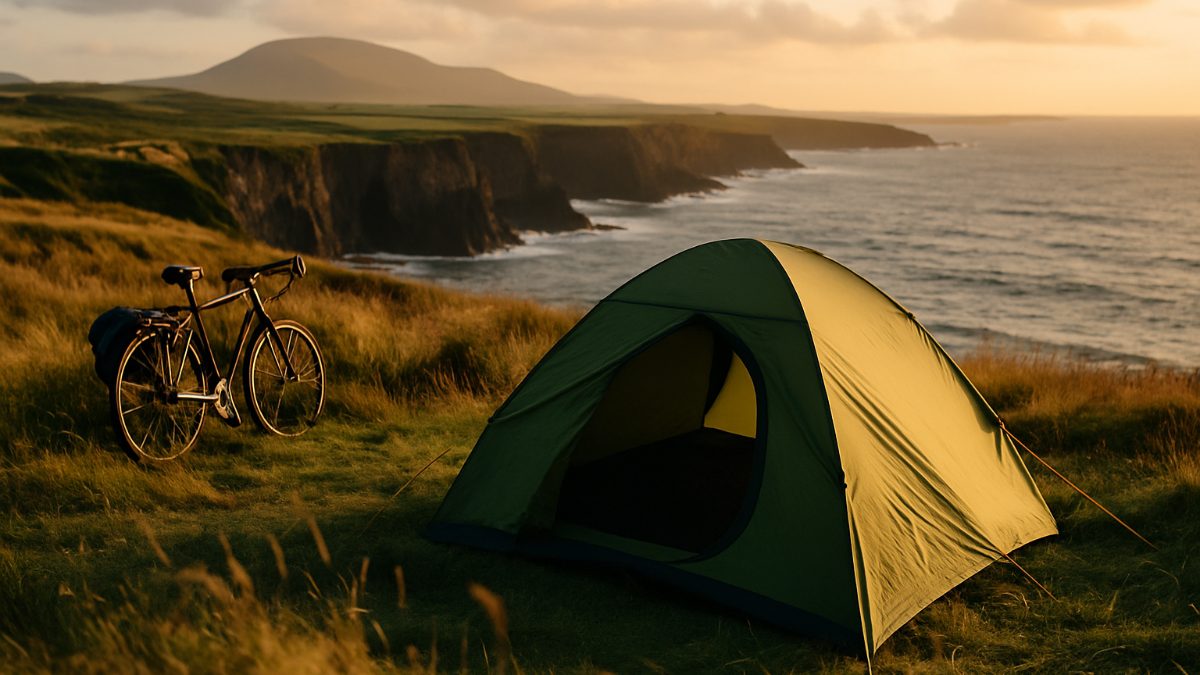
I had it all planned out. Seven nights along the Mayo coast, moving roughly every day or two, wild camping with everything on my back or strapped to the bike. I had read about Leave No Trace principles, I knew the basics of land access in Ireland, and I genuinely thought that preparation was enough. It was not.
What follows is an honest account of what went wrong, because I think that is more useful than a polished trip report that makes it all look effortless.
Mistake one: assuming flat ground would be easy to find
Mayo coastline is spectacular and almost entirely unhelpful for a tent. I spent the first evening walking back and forth across a grassy headland for about forty minutes looking for somewhere level enough to sleep on without sliding into my own sleeping bag zip. I eventually found a spot, but it was angled enough that I woke twice in the night having drifted sideways. The lesson is obvious in hindsight: look for flat ground first, view second. Beauty is cold comfort at two in the morning when you are wedged against the inner tent wall.
Now I would spend less time scanning the horizon and more time actually walking the ground and pressing on it with my foot before committing. Soft turf can look flat and be anything but, especially on coastal slopes where the grass grows to disguise the angle underneath.
Mistake two: underestimating how exposed the coast really is
I had camped in wind before. I had not camped in a Mayo Atlantic gale, which is a different category of experience. On night three, the wind picked up around midnight and I genuinely wondered whether my tent was going to survive until morning. It did, but one of the poles bent slightly and never fully recovered. The tent was pitched in what I thought was a sheltered hollow. It was not sheltered enough.
A windbreak, even a small one, matters enormously out there. A dry stone wall, a dip in the ground, a bank of heather, anything that breaks the direct line of the wind coming off the Atlantic. I got better at reading those features as the week went on, but I learned it slowly and painfully. If you are looking for a more sheltered overnight option on this stretch of coast, the Killary area offers a genuine change in the character of the terrain, more enclosed and noticeably calmer.
Mistake three: misreading access rights
Ireland does not have a statutory right to roam in the way Scotland does. Access to land here depends largely on the goodwill of landowners and on established custom, which varies by area and by who you happen to meet. On night four I pitched on what I thought was open commonage and a farmer came by the following morning, not angry exactly, but clearly not pleased either. We had a civil conversation and I moved on, but it rattled me.
The right thing to do, and what I would do now, is ask. It feels awkward, especially if your Irish is not great and theirs might be limited too, but most people respond well to someone being direct and respectful. "Would you mind if I pitched a tent for the night?" is a short sentence with a surprisingly good success rate. Avoid farm buildings, fields with livestock, and anything that looks actively managed. Open coastal headlands and mountain ground above the wall line are generally the safer bet, but never assume.
Mistake four: the Leave No Trace bit I kept getting almost right
I thought I was doing well on this front. I carried out all my rubbish, I used a trowel and buried waste well away from water, I tried to camp on durable surfaces. But on day five I made a small fire in a stone ring that someone else had clearly used before, which I thought meant it was acceptable. I am not sure it was. The ground underneath was scorched and the scar was obvious. The principle is no fires on the coast in summer, or at the very least keep them tiny, use existing fire spots sparingly, and make sure the wind cannot carry sparks.
The other thing I kept nearly getting right was water. I had a filter but I was lazy about using it when a stream looked clean. On this coast, with sheep on every hillside, every stream should be treated as suspect. I had no problems that week, but I was lucky more than careful.
Mistake five: packing for cycling and camping at the same time without thinking it through properly
I was moving between spots partly by bike and partly on foot, and my kit ended up being a compromise that suited neither mode properly. Too heavy to carry comfortably across rough ground, not quite organised enough for quick access on the road. Getting the bike setup right for multi-day touring is worth spending real time on before a trip like this, because when it goes wrong you feel it in your shoulders and in the extra ten minutes it takes to find anything.
I would go back and do it again, with all of this in mind. Mayo rewards the effort. Just go in with lower expectations of your own competence than I did.