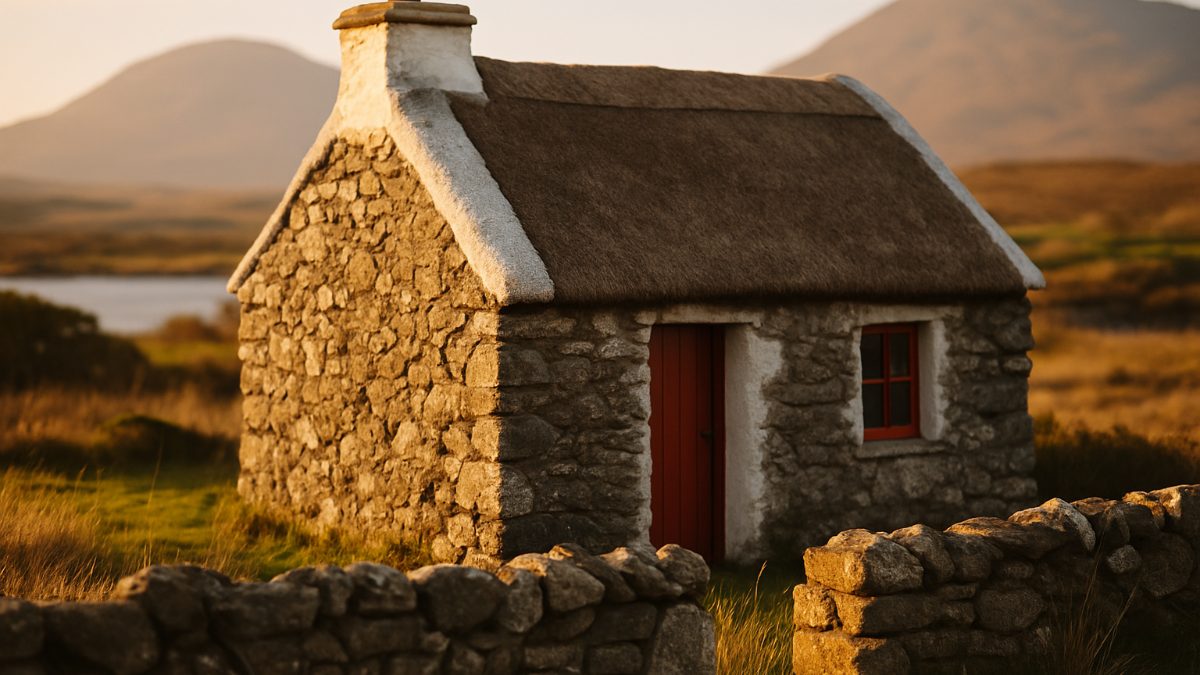
There's a particular kind of daydream that gets people. You're scrolling through property listings late on a grey Tuesday, and there it is: a stone cottage somewhere outside Clifden or up a boreen near Roundstone, asking price somewhere between tempting and "well, maybe if we sold the car." The walls are thick, the setting is wild, and in the photos at least, it looks like the most peaceful place on earth.
The question worth asking before you fall too hard for it is a simple one. Is the reality anything close to the picture?
What draws people to stone cottages in the first place
The appeal is real, not imaginary. These buildings have a presence that modern construction simply doesn't. Walls that might be half a metre thick. Stone that has been sitting in the same spot for a hundred and fifty years or more. A sense of proportion, low to the ground, tied to the land around it, that feels right in a place like Connemara in a way that a new-build bungalow rarely does.
People also buy into the idea of connection, to a landscape, to a slower way of living, to something that feels genuinely Irish rather than generic. If you've spent time cycling along the coast roads of Galway or Mayo, you'll know the feeling of passing one of these cottages and thinking, even for a moment, that you'd swap your whole commuter existence for it without hesitation.
And in fairness, that instinct isn't entirely wrong. People do buy them, restore them well, and end up with extraordinary homes. The ones who get there tend to go in with their eyes open.
The gap between the listing and the surveyor's report
This is where things get specific, and a little sobering.
Older stone cottages in the west of Ireland were not built with cavity walls, vapour barriers, or modern insulation. They were built to breathe. The walls absorbed moisture from the Atlantic air and slowly released it. That system worked reasonably well as long as the building was maintained in the traditional way, with lime mortar, lime plaster, and open fires generating constant warmth and airflow.
A large proportion of cottages on the market have had something done to them at some point, and not always helpfully. Cement pointing over original lime mortar is one of the most common problems. It looks tidy from the outside but traps moisture inside the wall instead of letting it escape. Portland cement render on internal walls does the same. Over time, this causes damp, salt damage, and in serious cases, structural deterioration. Reversing it is painstaking work and not cheap.
Then there's the roof. Original slate can last generations if it's maintained, but it needs maintenance. Many cottages have had corrugated iron or cheap modern materials put on at some point in their history. Rewiring, replumbing, septic tank compliance, upgrading windows to meet any reasonable standard of thermal performance. The costs stack up faster than most first-time buyers expect.
A rough rule of thumb that experienced buyers mention: budget the purchase price again for restoration, and don't be shocked if it goes beyond that. On a cottage bought for one hundred and twenty thousand euro, a sympathetic and thorough restoration could easily run another hundred thousand or more, depending on the condition and what you're trying to achieve.
The planning and grant picture
There is some genuine support available. The Vacant Property Refurbishment Grant has made a real difference for some buyers, covering a meaningful portion of renovation costs on qualifying properties that have been empty for a certain number of years. It comes with conditions, paperwork, and a requirement to use registered contractors, but for the right property it can be significant.
Planning rules around traditional cottages in sensitive landscapes can be strict, which is not necessarily a bad thing. Extensions need to be handled carefully, and not every local authority will approve the same things. It's worth speaking to a local architect early, ideally one who has worked on vernacular buildings in the west, before you commit to a purchase.
Who it actually suits
The people who seem happiest with stone cottage ownership are not usually those chasing an aesthetic. They tend to be people who have spent real time in the west, who understand what winters on the Atlantic coast involve, who have the patience for slow projects and the tolerance for a building that will ask things of them on an ongoing basis.
If you're the kind of person who loves the idea of growing things in a difficult garden, you might want to read about plants that actually survive a west Clare garden before you commit, because your outside space will present exactly the same challenges as your walls: exposure, salt, wind, and the need to work with the conditions rather than against them.
The romantic version and the practical version are not entirely incompatible. But they need to meet somewhere in the middle, and that meeting point usually starts with a good structural survey and a realistic budget rather than a late-night scroll through Daft.ie.