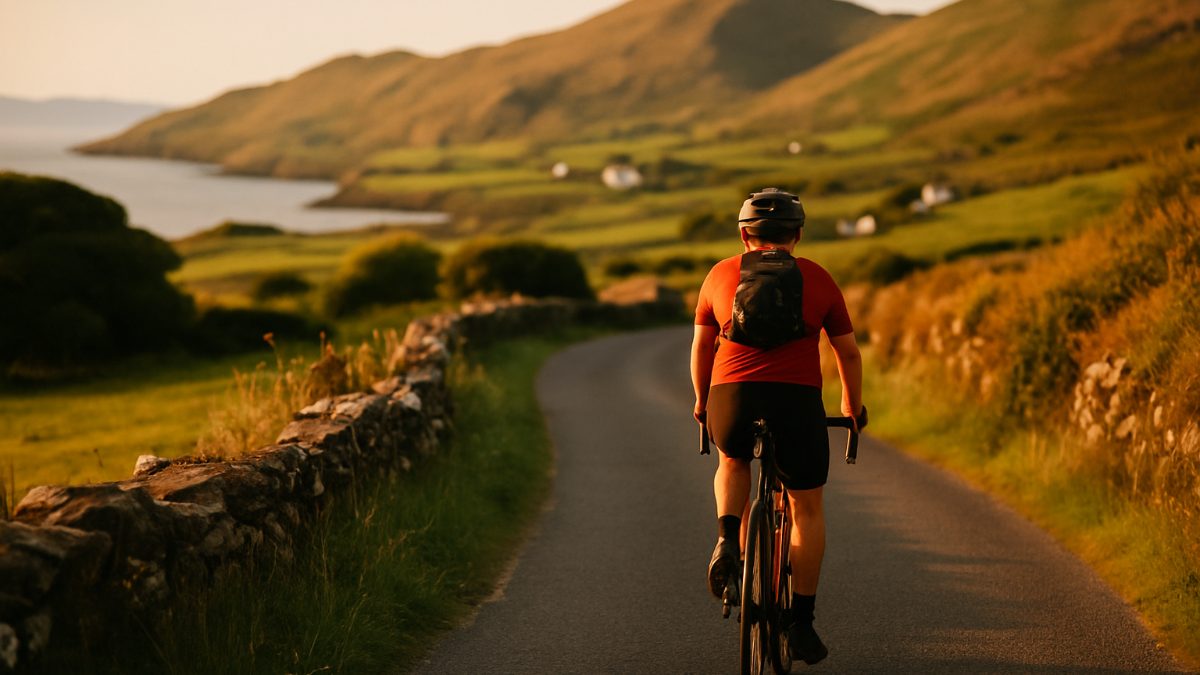
The Kerry section of EuroVelo 1 takes you around the Iveragh Peninsula, better known as the Ring of Kerry. It is one of the most spectacular stretches of Atlantic coastline anywhere in Europe, and also one of the most debated among touring cyclists: do you ride it clockwise or anti-clockwise? There is no single right answer, but there are some clear patterns worth thinking through before you set off from Kenmare or Killorglin.
The wind argument
Prevailing wind on the southwest Irish coast comes predominantly from the southwest. That is the starting point for almost everything else in this comparison. If you are riding clockwise, meaning south from Killorglin, through Cahersiveen and around to Sneem and back up to Kenmare, you will tend to have the wind coming at you from the side or from the front as you work down the south coast. Anti-clockwise from Killorglin, heading north and west toward Glenbeigh and Cahersiveen, you get more of a following wind on the exposed western sections where you really want it.
That said, Atlantic weather rarely behaves itself. A few days of easterly wind, which happens more than people expect, flips this logic entirely. If you have any flexibility in your schedule, check the forecast the night before rather than committing too rigidly to a direction based on theory alone. Anyone who has ground into a persistent headwind for hours will know the demoralising effect it has on an otherwise beautiful day. There is a longer reflection on that particular experience in this post about cycling into a headwind from Malin Head to Donegal Town, which covers the mental as much as the physical side of it.
How the gradients play out
The peninsula has several significant climbs, and the direction you travel changes how you meet them. The stretch between Cahersiveen and Waterville, and the climb up from Sneem toward Moll's Gap, are the two that most loaded tourers notice most.
Riding anti-clockwise, you approach Moll's Gap from the Sneem side, which is a long and relatively steady climb with the wind often at your back on the lower slopes. It is hard work but manageable. Clockwise, you descend this same side, which is fast and enjoyable, but you then face the climb from the Kenmare side, which is shorter and steeper. Some cyclists prefer to get a short sharp climb done rather than a long slow one. Others, especially those carrying panniers, find the long steady gradient much kinder on the knees. Think honestly about how your legs respond to climbing and what your bike is loaded with.
The road between Waterville and Cahersiveen has a few rollers that are unremarkable in either direction. The real exposure is on the Skellig Ring loop if you take it, where narrow roads and a stiff coastal breeze can make the small climbs feel considerably bigger than the map suggests.
Road exposure and traffic
The Ring of Kerry road is a tourist route, which means summer traffic is real. Coaches do the circuit clockwise as a rule, moving from Killarney through Killorglin and around. Riding anti-clockwise puts you going against the coach traffic rather than being caught behind a procession of them on narrow bends. This is probably the most practical, day-to-day reason that most experienced tourers on this stretch choose anti-clockwise, particularly between June and August.
The western coast road is more exposed regardless of direction. Wind comes off the Atlantic with nothing to slow it down between here and Newfoundland. If the forecast shows a strong southwesterly, that exposure matters more on the western leg than anywhere else on the circuit.
A reasonable starting point
For most loaded tourers riding in summer, anti-clockwise from Killorglin gives you the best combination: following or quartering wind on the exposed western sections, a long steady climb rather than a short brutal one at Moll's Gap, and the bonus of travelling against the coach traffic. But if the wind forecast strongly disagrees with you, trust the forecast. Make sure your bike is set up to handle a full day on exposed Atlantic roads before you start either way. A few small adjustments to gearing and luggage distribution make a bigger difference on a circuit like this than most people expect.